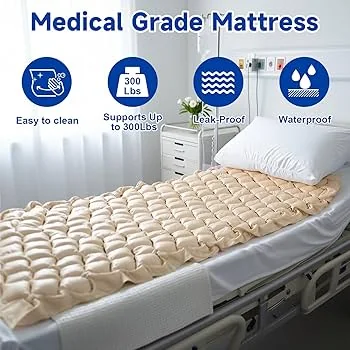
Ripple Mattress for Bedsores in Kenya
A ripple mattress prevents and helps treat bedsores by using a pump to inflate and deflate alternating rows of air cells, so the weight of the patient is lifted off each area of skin every few minutes instead of resting on it continuously. Pressure damage begins when unrelieved loading cuts off blood supply to skin over a bony point. On an ordinary mattress that loading is constant. On a ripple mattress it is interrupted on a cycle, typically every ten to twelve minutes. A complete set with pump costs KSh 6,000 in Nairobi. Clinical guidance on pressure ulcer prevention and management is published by NICE (CG179).
If a patient already has redness or a shallow open sore, a ripple mattress is the right surface and it should go under them now rather than after the wound deepens. It will take pressure off the affected area on a cycle, slow further breakdown and make repositioning less urgent. What it will not do is close an existing wound on its own. Stage 2 and deeper sores need clinical wound care alongside the mattress. Get the set, get a nurse to look at the wound, and keep repositioning at least twice a day.
Why pressure causes a sore in the first place
Skin and the fat and muscle under it are fed by small blood vessels. When a bony point such as the sacrum, a heel or a hip presses that tissue against a mattress, those vessels are squeezed shut. Tissue starved of blood for long enough begins to die, and the damage often starts in the deeper layers before anything is visible on the surface. This is why a sore can appear suddenly as a dark patch or a blister when the skin looked normal the day before.
The time involved is shorter than most families expect. Damage can begin within a couple of hours of continuous pressure in a frail or poorly nourished patient. It is faster still where the skin is damp from sweat or urine, or where the patient has been dragged up the bed rather than lifted, because friction and shear tear the tissue layers against each other while pressure is already reducing blood flow.
What the alternating cycle actually does
A ripple mattress is an overlay laid on top of the existing bed mattress. It is built from air cells arranged in two interleaved sets, odd and even, connected by tubes to an external pump. The pump inflates one set while letting the other deflate, then reverses. Every point on the patient's body therefore alternates between bearing load and bearing almost none, on a cycle of roughly ten to twelve minutes depending on the pump.
That interruption is the whole mechanism. Blood returns to the tissue during the low phase, which is what prevents the ischaemic damage that produces a sore. It is a different principle from a thick foam or memory foam mattress, which spreads load over a wider area but never removes it. Spreading pressure helps a mobile patient who shifts position in their sleep. It does not help an immobile patient who does not move at all, and that is the patient a ripple mattress is built for.
Stages, and what the mattress can do at each
| Stage | What you see | What a ripple mattress does |
|---|---|---|
| At risk | No damage yet. Patient immobile, frail or recently discharged | Prevention. This is where the mattress delivers the most value |
| Stage 1 | Redness over a bony point that does not turn white when pressed | Usually reverses the damage if pressure is removed promptly |
| Stage 2 | Broken skin, shallow open sore or a blister | Stops it deepening and supports healing. Needs wound care too |
| Stage 3 and 4 | Deep wound into fat, muscle or bone | Essential supportive surface, but this is a clinical case. See a nurse |
On darker skin, stage 1 is not reliably visible as redness. Judge by texture, temperature and hardness instead, and by whether the patient reports pain or burning at a particular spot. An area that feels warmer, firmer or boggier than the skin around it is damaged whatever colour it looks. Staging language follows the NPIAP pressure injury stages.
Choosing a set for a patient who already has sores
Two things decide whether the set will work for your patient: cell type and weight rating.
| Bubble cell | Tubular column | |
|---|---|---|
| Cell height | About 6cm | About 10 to 12cm |
| Typical weight rating | 100 to 135kg | 135 to 200kg |
| Best for | Prevention, stage 1, home care | Heavier patients, existing deep sores, long-term use |
| Kenyan price range | KSh 5,000 to 7,500 | KSh 13,000 to 27,900 |
Weight rating matters more than the price gap suggests. If the patient is heavier than the rating, they compress the cells fully and rest on the base mattress underneath. The pump keeps cycling and nothing reaches the skin. This is the single most common reason a family reports that the mattress "did not work". Check the rating against the patient's actual weight before ordering, not after.
Setting it up so it works
- Overlay, not replacement. It goes on top of the existing mattress, secured with the flaps at head and foot. It fits a standard Kenyan bed and a hospital bed alike.
- One sheet only, laid loose. Every extra layer between patient and cells reduces the pressure relief. Tucking the sheet tight does the same thing by flattening the cells.
- Check the tubes are not kinked or trapped under the bed frame. A pinched tube means one bank of cells never inflates, and that half of the mattress does nothing.
- Hang the pump on the footboard or set it on a firm surface with the air intake clear. It runs continuously and needs airflow.
- No incontinence sheet directly over the cells. Use a thin breathable protector under the sheet, not a thick plastic one on top.
- Float the heels. A pillow under the calves lifts the heels off the surface entirely. Heels carry very high pressure over a tiny area and are the one site where even a good mattress often is not enough on its own.
What it does not replace
A ripple mattress reduces how often a patient needs turning and how urgent each turn is. It does not remove the need. Reposition at least twice a day, and use the thirty degree tilt with pillows behind the back rather than rolling the patient fully onto a hip. Keep the head of the bed as low as is clinically acceptable, because raising it above thirty degrees lets the body slide down and shears the tissue over the sacrum.
It also does not substitute for wound care or for nutrition. An open sore needs assessment and dressing by a nurse. A patient who is not eating enough protein will not heal a sore no matter what they are lying on, and will develop new ones under pressure a well nourished patient would tolerate. If the patient is refusing food or losing weight, raise it with their clinician rather than waiting.
Call a nurse or doctor if the skin is broken, if there is discharge, bad smell, surrounding heat or swelling, if the patient develops a fever, or if an existing sore is getting larger despite good care. A stage 2 sore treated early usually closes. The same sore left two more weeks may take months.
Price and what is in the box
The complete set from Ripple Mattresses Kenya is KSh 6,000, reduced from KSh 8,500. That is the mattress, the pump, air tubes and connectors, a user guide, setup support by phone and a 6-month warranty on the pump. It is rated to 135kg. Comparable bubble sets in Nairobi run from about KSh 5,000 to KSh 7,500, so check what is included before comparing prices, because several sellers quote the mattress alone and charge separately for the pump.
Delivery inside Nairobi is same day and you pay after the rider arrives and you have inspected the set and confirmed it inflates. Outside Nairobi we ship countrywide by courier once the order is confirmed by phone, including Mombasa, Kisumu, Nakuru, Eldoret, Nyeri, Meru, Kisii and Thika. The shop is on Ronald Ngala Street, Poster Building, 4th Floor, Nairobi CBD, and you are welcome to come and see the set running before you buy.
Order a ripple mattress with pump
Complete set at KSh 6,000, down from KSh 8,500. Same-day delivery in Nairobi, pay on delivery after you inspect it. Countrywide courier after a phone confirmation.
Common questions
Can a ripple mattress heal an existing bedsore?
It removes the pressure that caused the sore and stops it deepening, which is a necessary condition for healing. It is not a treatment on its own. A stage 2 or deeper wound needs assessment and dressing by a nurse alongside the mattress.
How long before I see an improvement?
Stage 1 redness often fades within one to three days once the pressure is off. An open sore is measured in weeks and depends as much on wound care and nutrition as on the surface.
Do I still need to turn the patient?
Yes, but less often. Reposition at least twice a day, and keep all pressure off any area that is already red or broken until it recovers.
Does the pump run all the time?
Yes. It runs continuously while the patient is on the mattress. Switching it off overnight leaves the patient on a static surface at the hours when they move least.
What size patient does the set take?
The KSh 6,000 bubble set is rated to 135kg. Above that rating the patient compresses the cells onto the base mattress and the pressure relief stops working, so a tubular column set is the right choice instead.