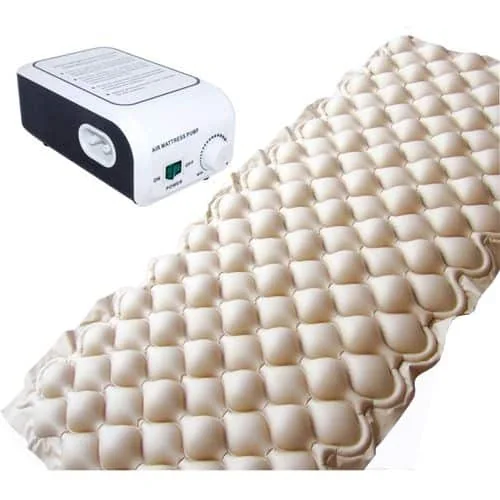
How to Use a Ripple Mattress
Lay the ripple mattress directly on top of the existing mattress, tuck the flaps under the head and foot, connect both air tubes to the pump, hang the pump on the bed frame and leave it running continuously. The pump must stay on for the alternating cycle to work. Switching it off leaves the patient on a flat deflating air pad with no pressure relief, which is worse than an ordinary mattress. Set the pressure so a flat hand slides between the patient's sacrum and the base mattress without touching it.
Lay the ripple mattress directly on top of the existing mattress with the air cells facing up and the tube end at the foot of the bed. Hang the pump on the footboard or place it on the floor, then push both air tubes onto the pump outlets until they click. Plug in and switch on. Wait 20 to 30 minutes for the cells to inflate fully before putting the patient on it. Set the pressure dial so that you can just slide a flat hand between the deflated cells and the patient's sacrum. Leave the pump running continuously.
Step by step setup
- Position the mattress. Lay it on top of your existing mattress, cells facing up, with the air tubes exiting at the foot of the bed. Do not put a thick blanket or plastic sheet between the ripple mattress and the patient, it blocks the pressure relief.
- Secure the flaps. Tuck the flaps at the head and foot under the base mattress so the ripple mattress cannot slide.
- Mount the pump. Hang it on the footboard using the built-in hooks, or set it on the floor. Keep it off carpet and away from curtains so the air intake stays clear.
- Connect the tubes. Push both connectors firmly onto the pump outlets until they seat. A loose connector is the single most common reason a mattress fails to inflate.
- Inflate. Plug in, switch on, and give it 20 to 30 minutes to reach full pressure before the patient lies down.
- Set the pressure. With the patient lying flat, slide a flat hand palm-up under the deflated row of cells at the sacrum. You should be able to slide it in with slight resistance. Too easy means the pressure is too low, too tight means it is too high.
- Cover it. Use one thin cotton bedsheet over the mattress. Nothing thicker.
How to set the pressure for the patient's weight
Most pumps have a single dial rather than a numbered scale, so the hand test above matters more than the dial position. As a starting point, turn the dial low for a light patient under 50kg, mid-range for 50 to 80kg, and high for 80kg and above. Then adjust using the hand test. Check it again after a few hours, and re-check whenever the patient's weight changes noticeably, which happens often during long illness. A mattress set too soft lets the body bottom out onto the base mattress, which removes the pressure relief entirely.
How does the alternating cycle work?
The pump feeds two separate sets of air cells through two tubes. It inflates set A while set B deflates, then reverses, on a cycle of roughly 6 to 12 minutes depending on the model. At any moment the patient's weight is carried by half the cells, and the skin over the other half has no load on it and full blood flow. Over an hour every part of the back, hips and heels gets several unloaded periods. That is the whole mechanism, and it is why the pump must stay on rather than being switched off at night.
Daily use checklist
- Check that both tubes are still connected and neither is kinked under the bed.
- Confirm the cells are still alternating by resting a hand on the mattress for a minute.
- Inspect the skin over the sacrum, heels, hips and shoulder blades once a day in good light.
- Keep the sheet dry and wrinkle-free. A wrinkled sheet creates its own pressure line.
- Reposition the patient at least twice a day even with the mattress running.
Cleaning and maintenance
Wipe the PVC surface with a damp cloth and mild soap, or a diluted disinfectant if there has been soiling. Dry it fully before use. Do not machine wash the mattress, do not use bleach at full strength, and never immerse the pump in water. Clean the pump's air filter every few weeks by removing the cover and rinsing or replacing the foam pad, since a clogged filter is the most common cause of weak inflation. Store the mattress rolled rather than folded, because sharp folds crack the PVC at the crease.
Troubleshooting
| Problem | Most likely cause | Fix |
|---|---|---|
| Cells will not inflate | Tube not fully seated on the pump outlet | Disconnect and push both connectors on firmly until they click |
| Inflates slowly or weakly | Clogged pump filter | Clean or replace the foam filter pad behind the pump cover |
| One side stays flat | Puncture in a cell, or a kinked tube | Straighten the tube first. If the cell still fails, the cell needs patching or replacing |
| Patient bottoms out | Pressure set too low for their weight | Raise the dial and repeat the flat-hand test at the sacrum |
| Pump runs but never alternates | Faulty valve unit | Contact us for warranty service. Replacement pumps are available on 0710 470 180 |
Order a ripple mattress with pump
Complete set at KSh 6,000, down from KSh 8,500. Same-day delivery in Nairobi, pay on delivery after you inspect it. Countrywide courier after a phone confirmation.
Common questions
How long before the patient can lie on it?
Allow 20 to 30 minutes from switch-on for the cells to reach full pressure. Putting the patient on early gives a false reading when you set the pressure.
Should the pump be switched off at night?
No. The pressure relief only happens while the cycle is running, and night is when a patient goes longest without being repositioned.
Can I put a mattress protector over it?
Use one thin cotton sheet only. A thick protector or a plastic sheet blocks the alternating pressure from reaching the skin and cancels the benefit.
What happens during a power cut?
The cells hold air for a while and the mattress stays usable as a static surface. Reposition the patient manually until power returns, then let it re-inflate.
How do I know the pressure is set right?
Slide a flat hand palm-up under the deflated cells at the patient's sacrum. It should go in with slight resistance. Too loose and they are bottoming out, too tight and the pressure is higher than it needs to be.